
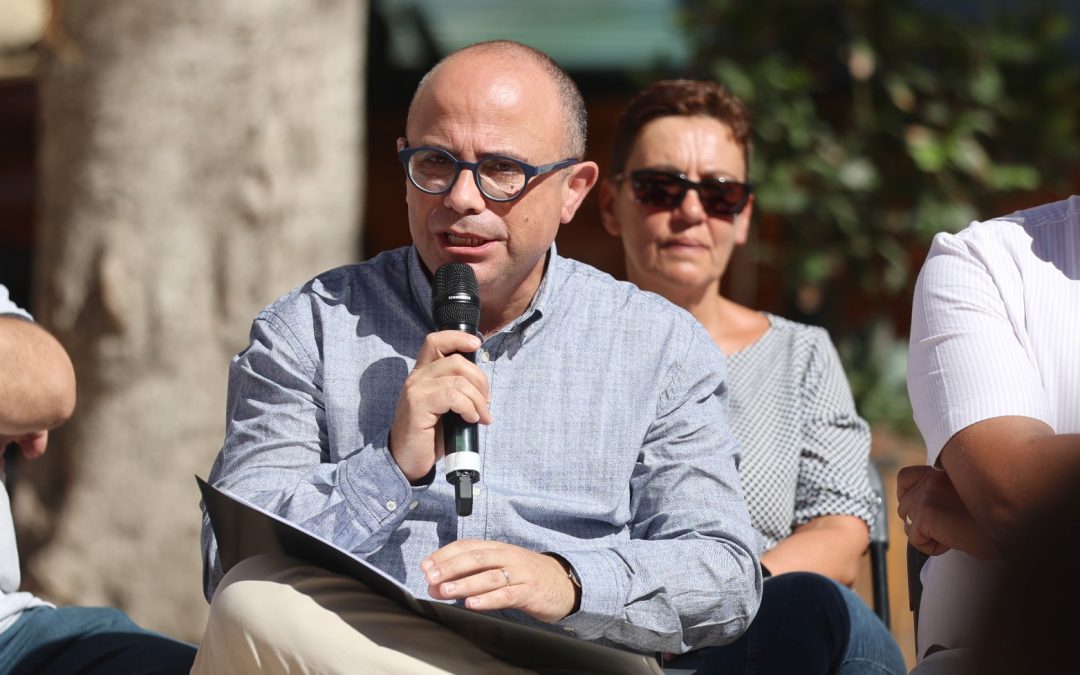
In this interview Mr Daniel Borg, the Gozo Business Chamber’s CEO, argues that Gozo should direct its efforts to balance the growth of existing sectors while consolidating new high-value niches, while pursuing quality and sustainability. Having been in this role for seven years, Mr Borg, highlights that it is time that Gozo ditches the mindset of insularity and limitations and embraces the concept of “islandness” to harness unique opportunities. He further emphasizes that as improved connectivity will have a major socio-economic impact, Gozo’s growth also depends on supporting start-ups, youth programmes and innovation hubs.
The Gozo Business Chamber represents the variety of industries in Gozo, from the basic primary industries to the secondary and service sectors. If you had to prioritise, should Gozo focus on scaling existing sectors or building entirely new ones? Why?
Ideally, there should be a mix. We should be able to continue strengthening what we already have, but we must not shy away from continuously looking towards the future. By scaling existing sectors, this does not mean that these sectors, such as, tourism or construction, will remain as they are, but that they will change to adapt to future needs and to what our economy really needs. In both cases, there should be a move towards a quality-driven product. Both areas present significant challenges given their impact on the environment. Consequently, they should be strengthened by reviewing their economic model and by seeing, both as a country and as a region, what we want to achieve. In this case, both Malta’s Vision 2050 and the Gozo Regional Development Strategy should be our benchmarks. Nonetheless, what I think is most necessary now is that we prioritise our efforts towards diversifying our economy. The success of the Queen Mary University of London Malta Campus in Gozo shows that high value-added niches can be successful in Gozo. I believe that, as an island region, we should focus more on these niches. In this case, there is an exciting emerging tech scenario on the island, which is evolving, and given the right enabling environment, can eventually thrive and succeed further.
What does a realistically successful Gozo economy look like by 2030?
While I believe that existing sectors will remain important, we should aim towards a more diversified and sustainable economy and given all the efforts being made, I believe that we are moving in this direction.
As an island that is part of an archipelago, one cannot avoid mentioning the notion of ‘double insularity’. Is insularity still an underestimated cost for Gozo’s businesses, or have we learned how to live with it or possibly even turn it into an advantage?
As an island, the issue of accessibility will continue to remain of strategic importance, and we need to continuously work on improving accessibility to Gozo. However, I believe that to succeed, our perspective should change. Recently, I attended the Global Sustainable Islands Summit. In his keynote intervention, Professor Godfrey Baldacchino mentioned that we should focus not on the aspect of insularity, but on ‘islandness’. ‘Insularity’ is associated with limitations, while ‘islandness’ is associated with grasping and reaping all the potential of islands. During the three-day discussion, it was interesting to note how islands around the world are working on this aspect. Given the significant advances in technology, islands today present significant opportunities which we should be able to grasp. Gozo can be a region that, given the right enabling environment, can contribute towards the nation’s economic success.
We have recently seen new plans in maritime transport that are meant to facilitate travel to and from Gozo. What is the envisaged socio-economic impact on Gozo?
Accessibility will always remain key for Gozo. Consequently, the socio-economic impact of the envisaged investment will be significant. It shows a commitment that the Government will continue to invest in Gozo and is thus an important signal to both present and future potential investors. Apart from this, it is also important to mention the work that is currently being undertaken in the Mġarr Task Force, which, given the investment being made in the ships, is also looking towards important projects such as the expansion of the port of Mġarr and also alternative berthing facilities around the island.
How important does the Gozo Business Chamber rate the Gozo Rural Airfield project, both from a connectivity and the stimulation of a potentially new economic niche in Gozo during General Aviation activities?
I believe that the Gozo Rural Airfield will also be another important project for Gozo. From a connectivity aspect, it will provide an important link to the airport, apart from the potential it has to provide a reliable link to other nearby territories, including other islands. As regards new economic niches, I believe that it could provide significant opportunities with respect to the drone industry, and I believe that if, apart from this, we also link the aspect of research and involve universities and research entities, the sector has the potential to continue to grow.
As the Gozo Business Chamber, one of the roles is to influence decisions that improve the business landscape. What policies does the Gozo Business Chamber advocate as needed right now to help take Gozo to the next level?
I think that right now our policies need to be directed towards enabling a start-up ecosystem in Gozo with a focus on the tech and digital sector in areas such as, for example, customised software solutions, and digital marketing. I believe that, given the right physical environment, such as the Digital Innovation Hub, and the blending of experienced companies and start-ups, the potential in this area is significant. I believe that our policies, however, need to be directed towards formulating specialised programmes for youth, which can assist them to develop their own ideas in Gozo. In this sense, the Gozo Business Chamber, together with other entities, already has the Youth4Entrepreneurship Programme. I would love to see this programme being developed further to assist youth in really implementing the idea that they pitch.
We also need to reach out to younger ages in primary and secondary schools, through educational hands-on programmes which expose them to the idea that they can create their own employment opportunities on the island.
At this point in time, how can Gozo grow economically without losing its identity and quality of life?
In this sense, like in all islands, the balance is a very delicate one. Our present model has not proven to be sustainable from an environmental aspect. In order to grow economically without losing our identity and quality of life, we need to move towards high-value economic niches which can ensure significant economic growth without impinging on our environment.
InvestGozo thanks Mr Borg for sharing his perspective on Gozo’s economic future and opportunities.